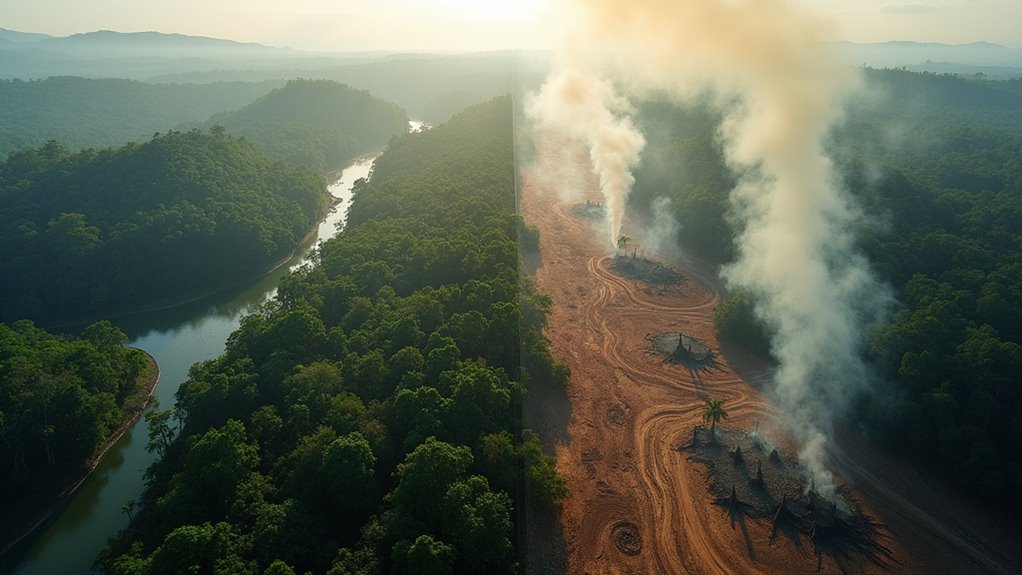


Climate scientists have been right for 50+ years, yet world leaders keep mashing that snooze button like hungover uni students. The models nailed it – from Hansen’s 1988 predictions to today’s 1.75°C reality check. Meanwhile, Arctic ice melts faster than expected, oceans heat up beyond projections, and Finnish forests flip from carbon sink to source. We’re racing toward a possible 5°C spike by 2100, but hey, what’s another decade of inaction? The truth gets darker from here.

While climate scientists have long been accused of crying wolf, their models are now howling with vindication. The data doesn’t just speak – it screams. With 2024 smashing temperature records and likely hitting the dreaded 1.5°C threshold, those decades-old climate projections are proving eerily accurate. In fact, 14 out of 17 model projections are indistinguishable from what’s actually happened.
Once dismissed as doomsayers, climate scientists now stand validated as their models match reality with chilling precision.
But here’s the kicker – these models weren’t alarmist enough. They’ve consistently underestimated how quickly our planet would heat up. The Arctic’s melting faster than predicted, oceans are absorbing more heat than expected, and sea levels are rising at the upper end of projections. Scientists warn that extreme weather events will continue intensifying, with record-breaking heat and hurricanes becoming more frequent. The presence of clouds creates a significant challenge, as they introduce a ±4.0 Wm² uncertainty in climate calculations. It’s like watching a horror movie where the monster arrives earlier than anyone thought possible.

January 2025 hit a staggering 1.75°C above pre-industrial levels, while the last ten years have been the warmest on record. Trees and forests, our trusty carbon-munching mates, are starting to wave the white flag. Finnish forests have even switched from carbon sink to source – yeah, you read that right. They’re now adding to the problem instead of helping solve it. As ecosystems face disruption from climate shifts, the human and economic toll of these changes is becoming increasingly evident, as communities face devastating impacts from climate-related disasters. Integrated efforts, from policy reforms to grassroots initiatives, are crucial in addressing these challenges effectively. To enhance resilience, communities are adjusting infrastructure and improving disaster response systems in anticipation of worsening conditions.
The models are telling us we’re headed for a potential 5°C temperature rise by century’s end if we keep hitting the snooze button on emissions reductions. That’s not just uncomfortable – it’s catastrophic. We’re talking about more intense heatwaves, stronger storms, and weather patterns that’ll make today’s extremes look like a gentle spring breeze.
But here’s the real gut punch: despite having decades of increasingly accurate predictions, we’ve responded with all the urgency of a sloth on sleeping pills. The models have been right about stratospheric cooling, regional precipitation changes, and even the intensification of tropical cyclones. They’ve nailed it time and time again, yet we’re still debating whether to take serious action.

The science isn’t just solid – it’s rock solid. Ten out of 17 model projections align perfectly with observations, and some predictions from the 1970s-2000s have proven remarkably skillful. Even Hansen’s 1988 model, which slightly overestimated warming due to pollution level changes, got the basic physics spot-on.
There’s a glimmer of hope in the prediction that 90% of increased energy demand could be met by renewable and nuclear power by 2025. But that’s only if we finally wake up and take action. The models aren’t just screaming anymore – they’re throwing evidence in our faces, backed by real-world observations that are becoming increasingly difficult to ignore.
The question isn’t whether the science is right – it’s whether we’ll finally stop hitting snooze before it’s too late.
Frequently Asked Questions
How Accurate Were Climate Models From the 1970S and 1980S?
Those old climate models were surprisingly on point.
ExxonMobil’s projections from the 70s and 80s nailed it with 63-83% accuracy – better than NASA scientist James Hansen’s 1988 predictions.
Most models from that era correctly forecast global warming trends, CO2 impacts, and when we’d first detect human-caused warming.
Sure, they weren’t perfect with some dodgy estimates of CO2 sensitivity, but overall? The science was solid.
Pretty damn impressive for primitive tech.
Can Climate Models Predict Local Weather Patterns and Regional Impacts?

Climate models crush it at global predictions but get wobbly when zooming into your backyard.
Sure, they’re getting better at regional forecasting thanks to fancy downscaling techniques and beefier computers.
But local weather? That’s still a proper challenge, mate.

Think of it like trying to predict where individual waves will break in a storm – you know rough seas are coming, but pinpointing exact spots is dodgy.
Natural variability’s a real mongrel at local scales.
What Role Does Artificial Intelligence Play in Modern Climate Modeling?
AI is revolutionising climate modeling with a swift kick to old-school methods.
It’s smashing through computational barriers, cranking out 100-year predictions 25 times faster than traditional models.

It’s actually more accurate, reducing errors by a third and nailing those tricky small-scale processes like cloud formation that used to be a nightmare to model.
Sure, there’s still work to be done, but AI’s already making those supercomputers look like dinosaurs.
How Do Scientists Test and Validate Climate Model Predictions?
Scientists put climate models through the wringer using multiple validation techniques. They compare predictions against historical data, run “hindcast” experiments to simulate past climate, and test against paleoclimate records.
It’s not perfect – long timescales and natural variability make things tricky.
But by using statistical metrics, evaluating across different scales, and analysing model performance for various climate patterns, they can assess how well these models actually work.
No mucking about.
Why Do Different Climate Models Sometimes Produce Varying Temperature Increase Projections?
Different climate models spit out varying temperature projections because they’re built differently – like cars with different engines.
Each model makes unique assumptions about Earth’s complex systems, from cloud behaviour to ocean circulation.
Throw in varying levels of detail, different mathematical equations, and distinct ways of handling feedback loops, and boom – you’ve got a range of results.
It’s like multiple architects designing the same house – similar blueprint, different executions.